
Over the past few months, I have been compiling all archival material related to Clifton Street Cemetery into a single comprehensive document. The most fascinating part of this work is how names previously concealed in these unassuming tomes can be brought to the surface. Countless forgotten stories can be unearthed, built upon, and subsequently incorporated into the narrative history of the cemetery and the city. Two noteworthy figures who emerged during my process of rediscovery were Mrs. Anna Orr Hunter and Miss Anna Hunter. These women contributed significantly to girls’ education in Belfast throughout the nineteenth and early twentieth centuries.
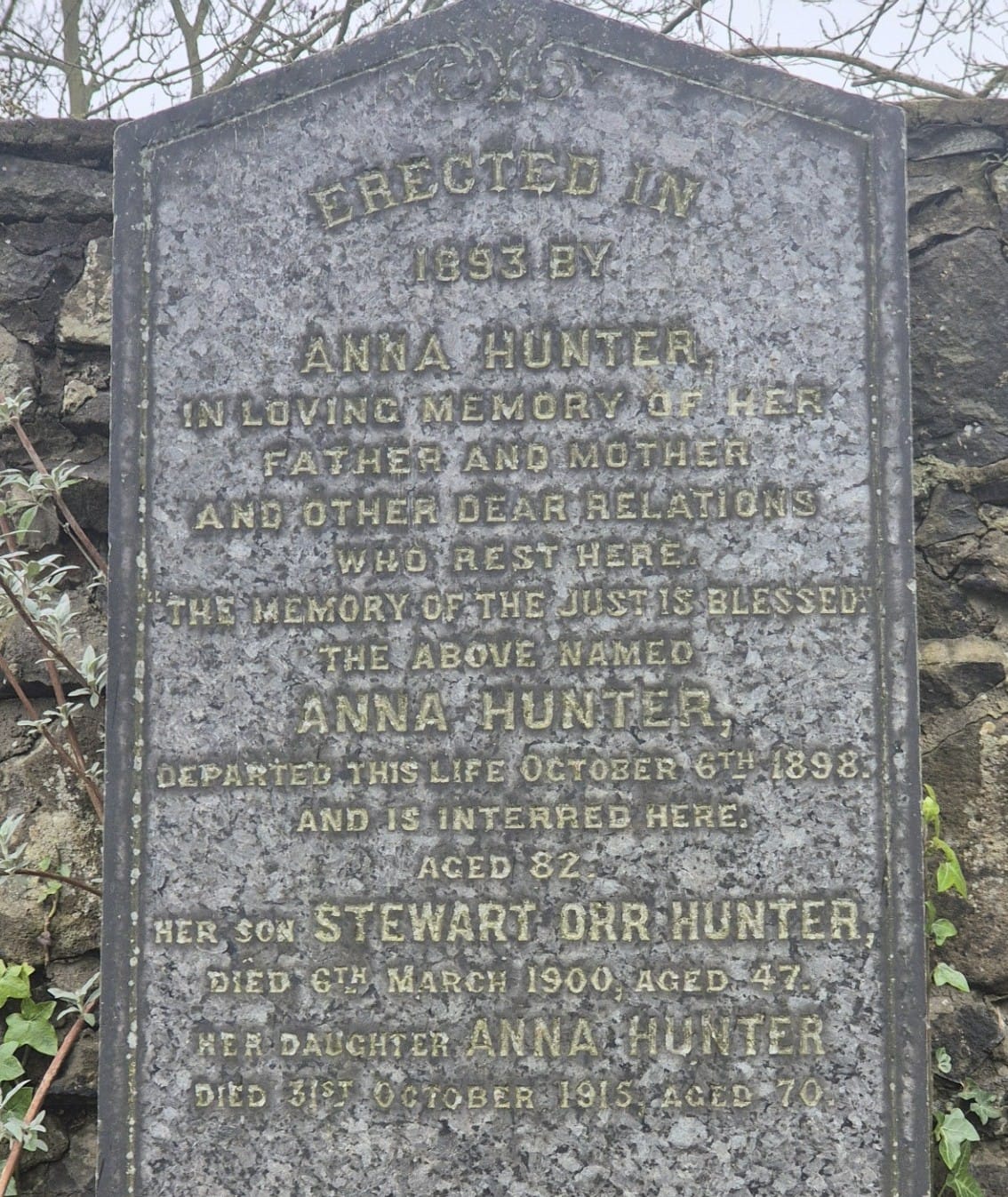
The mother and daughter shared the same name and occupation, and were buried in the same plot in Clifton Street Cemetery–Mrs. Hunter in 1898 and Miss Hunter in 1915 respectively. William Orr, the father of Anna Orr Hunter and Grandfather of Anna Hunter, purchased this wall plot in 1822 to serve as a family burying ground. The author, Peter Ross, describes Cemeteries and Burial Grounds “…[as being like] libraries of the dead, indexes to lives long gone,” and it is in the burial records, that we can gain important information about individuals, such as age, date of birth, date of death, and sometimes, even close relations.
After finding this initial information from the burial records, the next task was to find evidence of the Hunters elsewhere throughout their lives. This led to extensive consultations with print media from the time, where practically all the following information was collected.
William Orr was a successful linen merchant and bleacher who worked and resided in West Belfast at an expansive 26-acre property named Glenalina. Business success and personal affluence enabled him to acquire an impressive site in the cemetery. It is unclear how many children Orr had, but his second daughter, Anna, was born in 1815.
Unfortunately, Anna Orr’s childhood and adolescent life is shrouded in mystery due to limited documentation. It is likely that she resided in Belfast until her marriage in 1836. A notice of the union between twenty-year-old Anna and twenty-two-year-old William Steen Hunter of Deneight House in Lisburn was her next official entrance into the public record. Afterwards, the newly christened Mrs. Anna Hunter relocated to Deneight House with her husband to begin their family life.
Throughout the marriage, the couple had several children, including the aforementioned Miss Anna Hunter (or Miss Hunter) in 1845. Regarding Anna’s husband, Steen Hunter was also attached to the linen industry like her father William Orr. He regularly participated in agricultural contests throughout the 1830s and 1840s. However, the couple fell on hard times financially in the following decade due to the inability to pay back debt which led to Steen Hunter’s relocation to Canada.
Despite these troubles, in the years that followed Mrs. Anna Hunter laid the foundation for her family’s educational legacy. An announcement came in June 1862: “Mrs. Wm. S. Hunter purposes opening a Boarding and Day School for young ladies in Lisburn on the 1st of August 1862.” Adverts for the emergent school were continually featured in the newspaper throughout the summer months.
That August, the school opened on Seymour Street in Lisburn. Its establishment and sustainment were undoubtedly a family affair! From the beginning, the school’s promotional material specified Mrs. Hunter would be “assisted by her two daughters” before calling attention to the seventeen-year-old “Miss [Anna] Hunter…[who had] considerable experience as governess in the educational establishment conducted by Mrs. Byers of Belfast.” Mrs. Margaret Byers was another trailblazer for girls’ education in Belfast. She established the Ladies’ Collegiate School in 1859, which is now Victoria College.
After successful beginnings, the school reopened for the new academic term in August 1863. Now it was reported that “assiduous attention” would be devoted to the young ladies’ moral and intellectual development. This assertion made it clear that Mrs. Hunter believed ideal education for young women would not only shape their intellect, but also their behavior and personal values. The school did not have an overt religious affiliation, but Mrs. Hunter’s educational standards were directly influenced by her Anglican beliefs. She was described as striving to bestow a “solid, accomplished, and Christian education” on her students.
For the Hunter family, personal tragedy accompanied the school’s initial triumphs. In July 1863, William Steen Hunter died from fever aboard a ship in Fitzroy Harbor, Canada. This marked the loss of a father and husband of nearly thirty years. Nevertheless, Mrs. Hunter did not abandon her work. She continued to serve as Principal for the Boarding and Day School until her retirement over fifteen years later.
Under Mrs. Hunter’s direction, the school on Seymour Street garnered a positive reputation. With every notice published about the school, the public was repeatedly assured of her competence as an educational leader. She was referred to as “one of the pioneers of modern education” in reference to her recruitment of foreign governesses, local staff choices, and “progressive methods” that were more holistic.
Then, in 1870, Mrs. Hunter moved the school to 15 College Square East in Belfast. At the time, it was reported that Mrs. Hunter believed Belfast’s centrality would be advantageous for the school. Later, this decision would be credited to her “acting on the advice of influential residents in Belfast,” though those influential residents remained anonymous. Whatever the case, continued success after the move demonstrated how sought after Mrs. Hunter was as an educator.
Students who attended the school were taught by subject masters and prepared for Queen’s College (now Queen’s University) examinations. Although women were barred entry from Queen’s for another decade, Mrs. Hunter did not believe these social barriers should prevent the girls in her care from pursuing education how they could. This mindset was exemplified in how she raised her daughters who were highly educated in their own right and actively working to teach the next generation of young women. In 1882, Queen’s College became the first College on the island of Ireland to admit women to classes. Students were able to attend Art Classes in 1882, and allowed to attend Science Classes from the following year. It is possible that the pressure put on the College by Hunter and her student’s accelerated a change that was happening across the island.
Mrs. Hunter continued to work alongside her daughters after the move to College Square East. Miss Anna Hunter, and her sister Minnie, had also gained a favourable reputation based upon their “acknowledged ability and superior education.” As time passed, Anna played a substantial part in running the school before eventually stepping into her mother’s role as Principal. She oversaw the school’s second and final move to 4 Princess Gardens in 1887. This move was accompanied by a name change from Miss Hunter’s Ladies’ School to Princess Gardens School. Student numbers steadily increased after the move, eventually leading to various building expansions to adequately provide for the girls studying there.
Miss Hunter and Mrs. Hunter were often publicly praised in similar ways. Much like her mother, the public viewed Anna as nurturing the intellectual, religious, and character-related needs of her students. Moreover, passages configured her as a model for the girls in respect to all three categories.
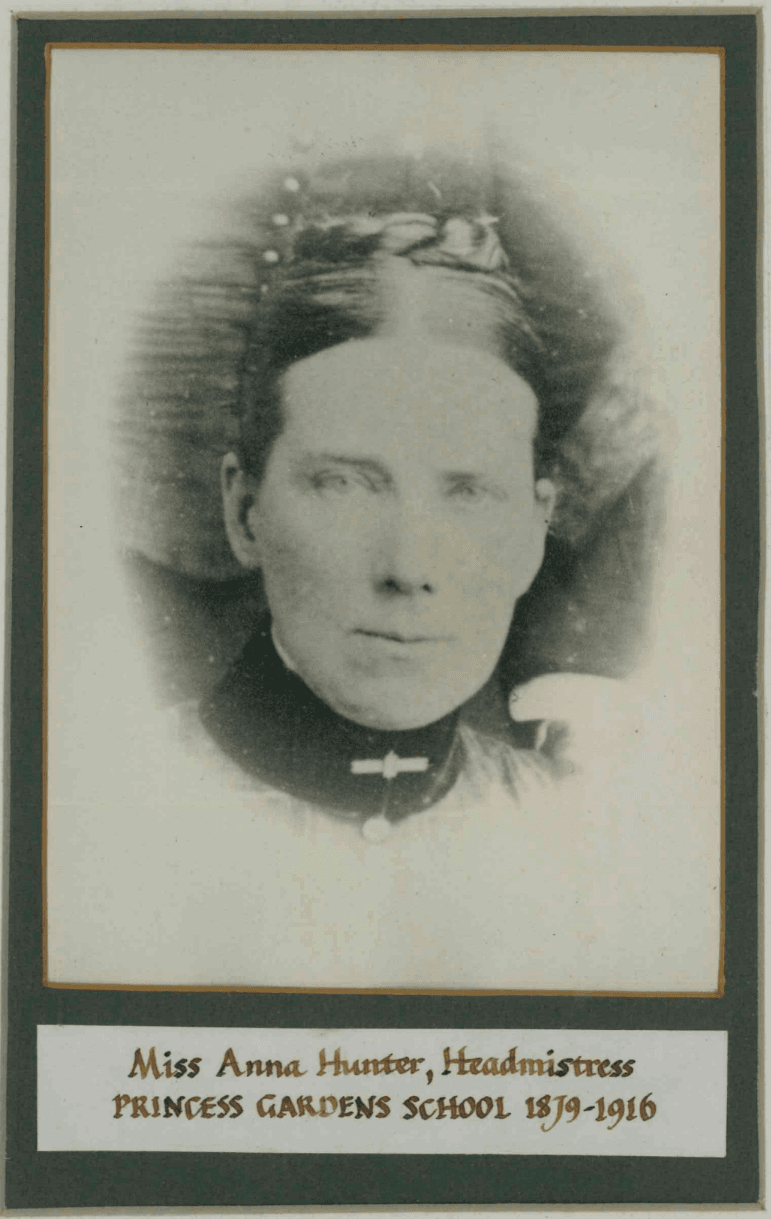
In her own words from the school’s annual report in 1896 she explained, “It is a manifest duty to our girls to give them every advantage and every opportunity which may prepare them to play a worthy part in the world.” Under Miss Hunter’s leadership, there was an emphasis on music, which her students excelled at. In addition to many academic achievements recorded in public examinations, many young women went on to achieve their associate diplomas from the London College of Music.
In 1898 another tragedy befell Miss Hunter when her mother died aged 82. Mrs. Hunter’s death was announced with a brief passage that made no mention of her life’s work. Unfortunately, she faced a similar fate in the cemetery burial records where neither her first name nor her occupation were mentioned. In circumstances like this, it feels very rewarding to be able to add details back into the limited story burial records can tell.
Based on available information it seemed Anna felt the loss of her mother deeply. The annual prize ceremony was usually held around September or October but was delayed that year in response to an unnamed event that caused Miss Hunter great sadness. Nonetheless, like her mother before her, she continued to dedicate herself to the school in the wake of personal loss.
Princess Gardens continued to grow numerically and in reputation with Miss Hunter at the head of the institution until her death from a stroke in 1915 at age 70. By then, she had spent over fifty years working at the school and steered it through every major transformation. In the burial records, she was recorded as a School Principal. Burial records condense so much of a person’s life into five or six categories on a page. However, the more I researched Miss Anna Hunter, the more I saw the extent that role title had dictated her life.
In the years after her death, she was commemorated in many ways. Princess Gardens established the Anna Hunter Memorial Cup, a prize awarded based on academic merit. Past students donated cots and equipment to the Belfast Hospital for Sick Children in 1936 in the former Principal’s name. Today, the school still exists as Hunterhouse College, the result of a merger between Princess Gardens and Ashleigh House School in 1987. This new name ties the present school to the women responsible for its existence.
It would be exceptionally difficult, if not impossible, to tell the story of one Anna Hunter without the other. Not simply because of their familial relationship, but because of their passion for the work they did and how it impacted the students they taught. Both in life and in death, the duo’s lives were considered alongside one another. Miss Hunter’s obituary from 1915 demonstrated this idea with effectiveness as it commemorated her but also contextualised her life first by remembering her mother. Arguably, this public recognition of Mrs. Hunter’s work in education was long overdue.
Now the story ends in the same place where it began for me, at Clifton Street Cemetery, where both women are laid to rest. Their names are not only recorded in the physical records of the site but etched into a stone that still stands today. Without the cemetery’s preserved records, there would have been no starting point for me to grab hold of. Research outcomes like this demonstrate the significance of the cemetery as a reservoir of historical information. How utilising this resource in North Belfast creates countless opportunities to encounter and preserve a vast range of stories. As I complete the compilation process for Clifton Street Cemetery archives, I look forward to exploring who and what I can and the places that process will take me.
Bernadette Pitt-Payne is an Archive Admin Associate for the North Belfast Heritage Cluster. Her research interests include gender, class, and social history in the Victorian era. She has a BA in History from the University of Illinois in Chicago and an MA in Public History from Queens University Belfast.