
Duncairn Presbyterian Church has undergone many changes since it was first built in 1862. After going through a multi-million pound refurbishment in 2011, the Duncairn Arts Centre operates as a cross-community culture and arts venue; a slight change of pace from a place of Presbyterian worship! However, there are still echoes of the old church life in the venue, including memorials to former ministers who dedicated significant portions of their life to Duncairn and the wider north Belfast community. Some of these memorials now find themselves in storage cupboards, or under stairs, as the footprint of their former church has changed around them. One such memorial commemorates the first minister of Duncairn- the Reverend Thomas Young Killen, who was appointed in 1862. Rev. Killen was minister at Duncairn Presbyterian Church for 24 years. During this period, he was instrumental in growing the congregation of this new church, and establishing it as a prominent place of worship in north Belfast. Through his preachings of peace and unity, Reverend Killen left a legacy of kindness behind him, not only in his congregation, but in the wider community as well.
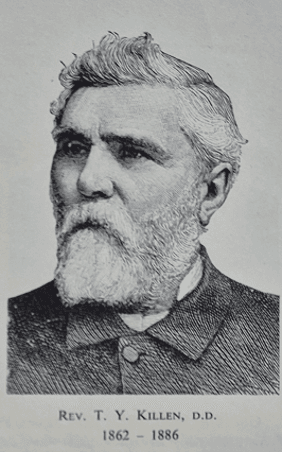
Thomas Young Killen was born on the 30th of October in 1826 to Edward Killen and Mary Young in Ballymena. Growing up in Glenwherry he was one of nine siblings, and came from a prominent line of presbyterian ministers with connections to Edward Brice (1569-1636), who is credited as the very first known Scottish Presbyterian minister on Irish soil. Though his father, Edward, was a merchant, the family connection to the presbyterian remained strong. Two of Thomas’ uncles, James Millar Killen and William Dool Killen were presbyterian ministers. Through our research, we have also discovered that these three brothers, James, Willam and Edward married three sisters: Mary, Anne and Martha Young!
Before Thomas came to north Belfast, he was a missionary in County Roscommon during the height of the Famine, and his journals recorded details of his experience in great detail, describing the horrific suffering and illness he witnessed during his time there. After his appointment as minister in Ballykenny, Rev Killen arrived in Belfast an assumed his new role as leader of Duncairn Presbyterian when the church opened in 1862.
Killen was minister at a time when divisive sectarian preachings were prevalent, with fellow ministers such as “Roaring” Hugh Hanna (1821-1892) and Henry Cooke (1788-1868) active alongside him, but he did not follow their example.
Instead, Killen was often described by his peers as “not an extreme man, but wise and judicious and kindly in all dealings will all with whom he came in contact”. From writing and publishing books about the Catechism (a teaching tool within Chirstian Churches) to becoming Moderator of the General Assembly working next to his uncle William, Killen was heavily involved with the Presbyterian Church, and established Duncairn as an important part Belfast’s religious landscape. The congregation more than doubled under his stewardship, demonstrating that his softer and compassionate approach resonated strongly with and commanded the respect of those in the community: “in the course of his ministry he became a much-loved pastor.” This widespread community and congregational love made his sudden death all the more shocking.
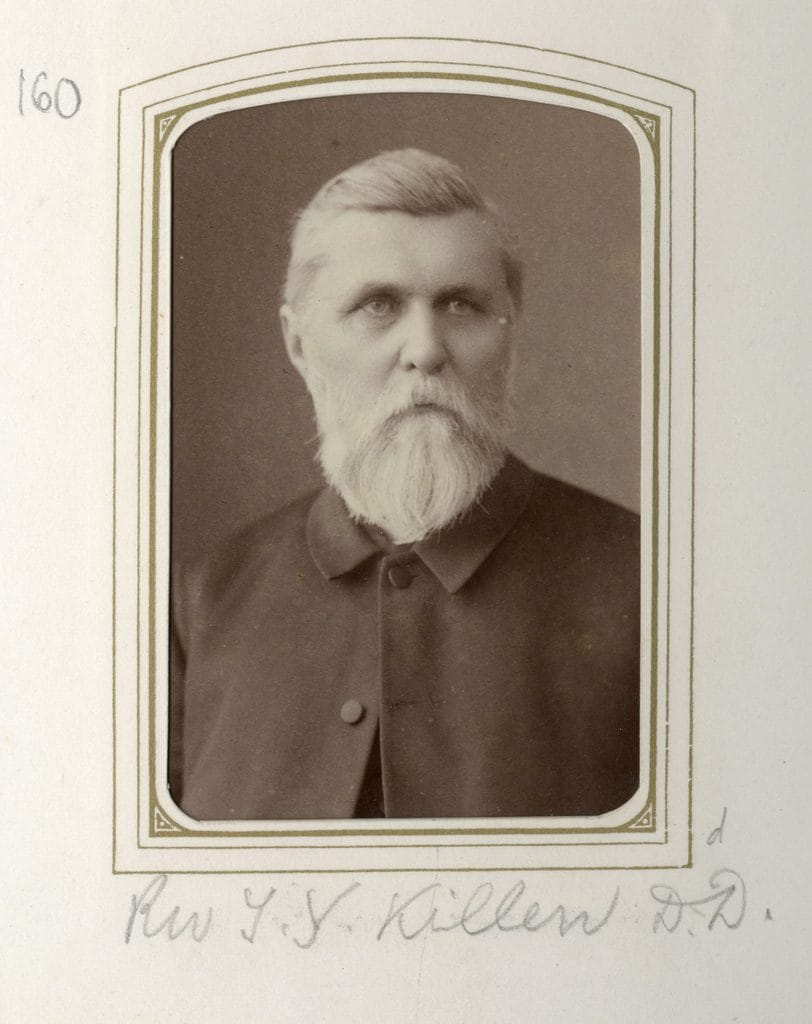
At just sixty years of age, Thomas Young Killen spend the morning with some congregation members, mentioning he didn’t feel well. He headed home in the afternoon that day, October the 21st in 1886, to his home at the Church manse to lie down, only to pass away from a seizure not too long after. When the news broke of his passing, the Duncairn congregation and members of the Belfast public alike were devastated. It was noted in the 1887 Duncairn annual report that his constant dedication to his work lasted up until his final day:
“he died at his work, and he [has] left behind an impression for good on his sorrowing congregation that will last throughout history”.
Reverand Thomas Young Killen was buried in Balmoral Cemetery after a funeral service at his beloved Duncairn Presbyterian. His congregation came in droves to say goodbye to their beloved minister and friend. It was noted by his peers that it would be incredibly difficult to fill the hole that he left at the Duncairn Presbytery and Belfast in general. His legacy of kindness and preaching were much needed during times of discord and unrest.
Though the story of his life has been overshadowed in the decades following his death, his message of compassion, kindness and community is one that still resonates within the walls of his former church. His memorial plaque at the Duncairn Arts Centre remains a quiet testament to his life and his dedication to his congregation and to north Belfast.
About the author: Brooke Norgaard has a BA in History Teaching from the University of Sioux Falls and a MA from Queen’s University Belfast in Public History. Her focus areas are women’s history, the Salem Witch Trials, dark tourism, and carceral history. Norgaard has spent years working at various history museums in the United States and is currently the Project Assistant for the North Belfast Heritage Cluster. All research has been conducted to a high academic standard and has been fully referenced. If you would like to know more about a story or piece of research, or if you wish to tell us about your own story, email us at: archiveproject@nbheritagecluster.org
